
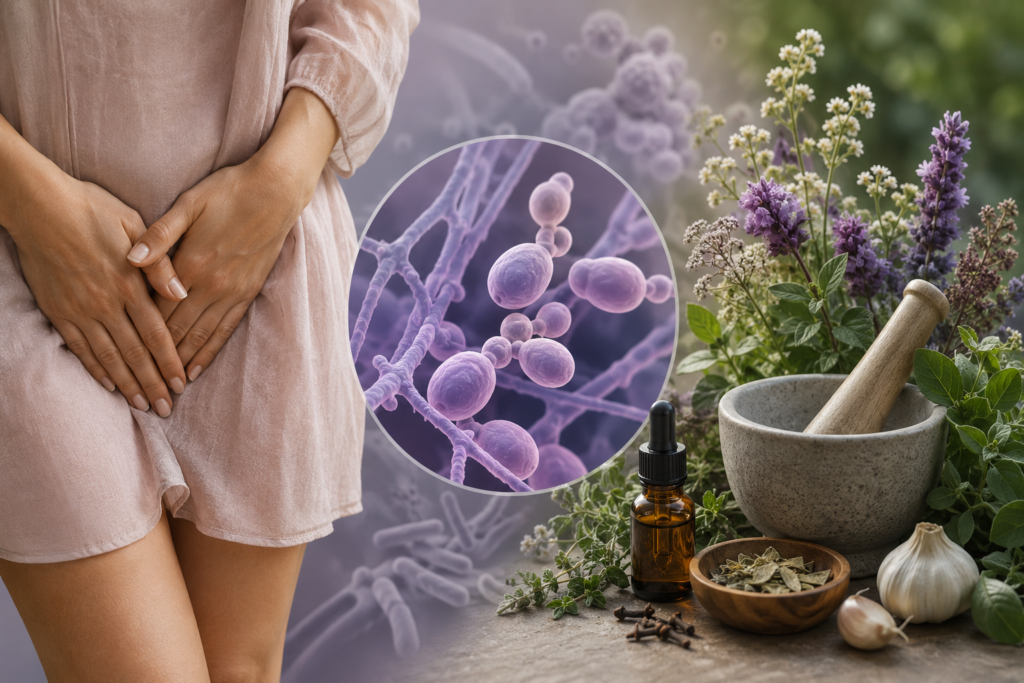
For many women, fungal infections are no longer an occasional issue. The symptoms return repeatedly: itching, burning, irritation, discomfort, altered discharge. Treatment may bring temporary relief, yet the imbalance often comes back weeks or months later.
What is becoming increasingly clear is that this is not simply a matter of “taking another antifungal.” A much larger story is unfolding — one involving resistance, environmental exposure, microbiome disruption, and the growing realization that our modern world is saturated with azoles.
What Are Azoles — and Why Are They Everywhere?
Azoles are antifungal compounds widely used in medicine to treat fungal infections. Medications such as fluconazole, miconazole, clotrimazole, itraconazole, and others belong to this group.
But what many people do not realize is that similar azole compounds are also massively used in agriculture as pesticides. They are sprayed on crops, fruits, grains, and vegetables to prevent fungal disease. As a result, azole residues and their metabolites increasingly end up in soil, waterways, and eventually drinking water systems.
In other words: our exposure is no longer limited to occasional medical treatment. We now live in an environment where fungal organisms are constantly exposed to azole pressure.
The Resistance Problem Is Real
This matters because fungi adapt. Scientists and public health organizations are increasingly warning that widespread agricultural azole use may contribute to resistant fungal strains that are also harder to treat medically. This is already a serious issue in certain invasive fungal infections, but it also helps explain why recurrent vaginal fungal imbalance is becoming increasingly stubborn in some women.
Repeated short antifungal treatments can temporarily suppress symptoms while simultaneously creating selective pressure favoring more resistant strains. And resistance is only part of the issue.
Azoles Are Not Biologically Neutral
Azoles are designed to interfere with fungal enzymes, but some compounds can also affect human cytochrome P450 enzymes involved in hormone metabolism and detoxification pathways.
Systemic azoles are associated with a wide range of possible side effects, including:
- liver toxicity,
- drug interactions,
- cardiac rhythm disturbances,
- endocrine disruption,
- adrenal effects,
- and hormonal interference.
Research on agricultural triazoles is also raising concerns about endocrine-disrupting potential. Experimental studies suggest that some triazole fungicides may influence steroid hormone pathways and exhibit anti-androgenic or anti-estrogenic activity.
This does not mean that every exposure is dangerous or that antifungals should never be used. In some situations they can be necessary and effective. But it does challenge the simplistic idea that repeated antifungal exposure is entirely without consequence — especially in a world already saturated with these compounds.
A Broader Way of Looking at Fungal Imbalance
Many health practitioners are now starting to ask a different question.
Instead of only asking: “How do we eliminate the fungus?”
the question becomes: “Why is the terrain allowing persistent imbalance in the first place?”
Recurrent fungal overgrowth is often connected to broader issues such as:
- microbiome disruption,
- chronic stress,
- hormonal imbalance,
- antibiotic history,
- immune dysregulation,
- inflammatory burden,
- metabolic dysfunction,
- and environmental pressure.
This is where plant-based strategies are gaining increasing attention.
Why Plants Are So Interesting in This Context
Plants are remarkably complex. Unlike single-molecule pharmaceutical approaches, many botanicals contain dozens or even hundreds of naturally occurring active compounds working together through multiple pathways. Researchers are exploring how certain plant compounds may help:
- support microbial balance,
- interfere with fungal biofilms,
- support mucosal health,
- modulate inflammation,
- and help create an environment less favorable to fungal overgrowth.
Traditionally used botanicals such as oregano, clove, cinnamon, thyme, garlic, pau d’arco, and polyphenol-rich extracts continue to attract scientific interest for their supportive role in microbial and intimate health. What makes this particularly interesting in the era of resistance is that plants rarely work through a single isolated mechanism alone. Their complexity may be one of their strengths.
Beyond Suppression
The future of fungal health may not lie in endlessly escalating suppression strategies. Instead, it may require a more ecological and integrative perspective — one that combines medical treatment when necessary with support for resilience, microbiome diversity, hormonal balance, and the body’s natural defenses.
Because perhaps the most important question is no longer: “How do we fight fungi harder?”
But rather: “How do we restore balance in a world increasingly pushing biology out of balance?”
REFERENCES
Dladla M, Gyzenhout M, Marias G, Ghosh S. Azole resistance in Aspergillus fumigatus- comprehensive review. Arch Microbiol. 2024 Jun 15;206(7):305.
Donders G, Sziller IO, Paavonen J, Hay P, de Seta F, Bohbot JM, Kotarski J, Vives JA, Szabo B, Cepuliené R, Mendling W. Management of recurrent vulvovaginal candidosis: Narrative review of the literature and European expert panel opinion. Front Cell Infect Microbiol. 2022 Sep 9;12:934353.
Akinosoglou K, Livieratos A, Asimos K, Donders F, Donders GGG. Fluconazole-Resistant Vulvovaginal Candidosis: An Update on Current Management. Pharmaceutics. 2024 Dec 4;16(12):1555.
Akinosoglou K, Livieratos A, Asimos K, Donders F, Donders GGG. Fluconazole-Resistant Vulvovaginal Candidosis: An Update on Current Management. Pharmaceutics. 2024 Dec 4;16(12):1555.
Schoustra SE, Debets AJM, Rijs AJMM, Zhang J, Snelders E, Leendertse PC, Melchers WJG, Rietveld AG, Zwaan BJ, Verweij PE. Environmental Hotspots for Azole Resistance Selection of Aspergillus fumigatus, the Netherlands. Emerg Infect Dis. 2019 Jul;25(7):1347-1353.
Faria-Ramos I, Farinha S, Neves-Maia J, Tavares PR, Miranda IM, Estevinho LM, Pina-Vaz C, Rodrigues AG. Development of cross-resistance by Aspergillus fumigatus to clinical azoles following exposure to prochloraz, an agricultural azole. BMC Microbiol. 2014 Jun 11;14:155.
Fisher MC, Alastruey-Izquierdo A, Berman J, Bicanic T, Bignell EM, Bowyer P, Bromley M, Brüggemann R, Garber G, Cornely OA, Gurr SJ, Harrison TS, Kuijper E, Rhodes J, Sheppard DC, Warris A, White PL, Xu J, Zwaan B, Verweij PE. Tackling the emerging threat of antifungal resistance to human health. Nat Rev Microbiol. 2022 Sep;20(9):557-571.
Dantas TS, Machado JCB, Ferreira MRA, Soares LAL. Bioactive plant compounds as alternatives against antifungal resistance in the Candida strains. Pharmaceutics. 2025;17(6):687.
Mishra KK, Kaur CD, Sahu AK, Panik R, Kashyap P, Mishra SP, et al. Medicinal plants having antifungal properties. In: Hassan BAR, editor. Medicinal Plants: Use in Prevention and Treatment of Diseases. London: IntechOpen; 2020.