
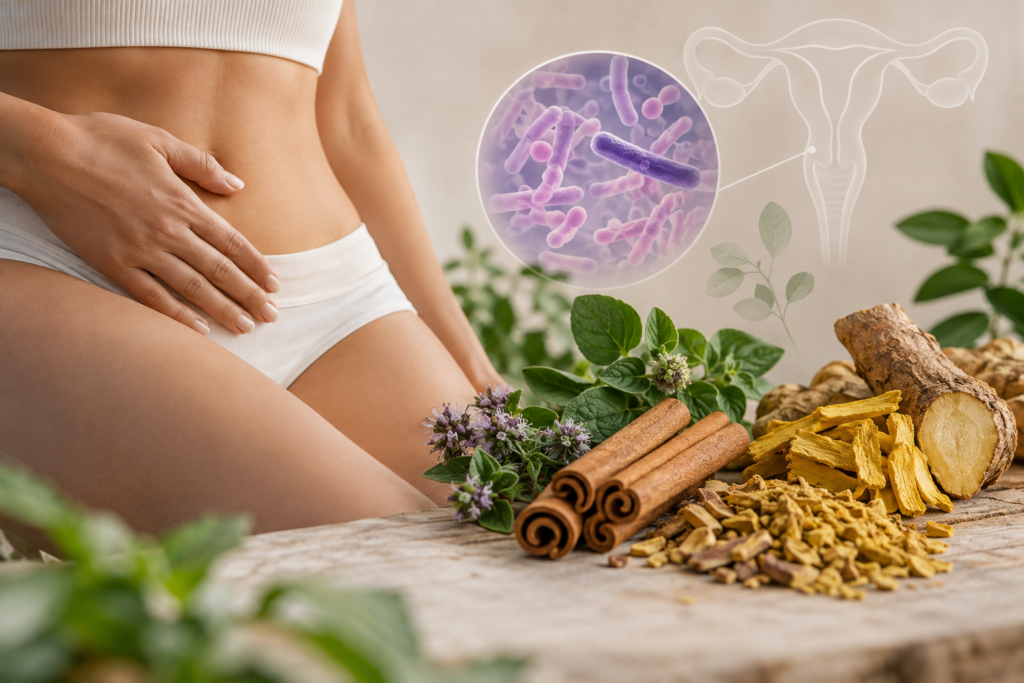
Bacterial vaginosis (BV) is one of the most common forms of vaginal imbalance. It occurs when the vaginal microbiome shifts: protective Lactobacillus bacteria decrease, while other, mainly anaerobic bacteria become more abundant.
Lactobacilli normally produce lactic acid, helping to maintain the naturally acidic vaginal environment. When their numbers decrease, vaginal pH rises and bacteria associated with BV can multiply more easily.
One of the key bacteria involved is Gardnerella. Together with other microorganisms, it can form a biofilm: a structured layer of bacteria attached to the vaginal wall. This biofilm protects the bacterial community and is thought to contribute to the persistence and frequent recurrence of BV.
This makes BV more than simply an overgrowth of one unwanted bacterium. From a phytotherapeutic perspective, several factors are therefore interesting: controlling disruptive bacteria, interfering with biofilms, supporting beneficial Lactobacillus species and helping maintain a healthy vaginal environment.
Several medicinal plants offer particularly interesting properties in this context.
Oregano: antimicrobial and antibiofilm activity
Origanum vulgare is rich in carvacrol and thymol, compounds known for their antimicrobial properties.
Carvacrol can interact with bacterial cell membranes, affecting their integrity and normal function. Oregano constituents have also shown antibiofilm activity, which is particularly relevant when bacteria are protected within persistent microbial communities.
Together, these antibacterial and antibiofilm properties make oregano an interesting botanical in the context of vaginal dysbiosis.
Ceylon cinnamon: antimicrobial and antibiofilm properties
Cinnamomum zeylanicum contains cinnamaldehyde as one of its main active constituents, alongside eugenol and various polyphenols.
Cinnamaldehyde has broad antibacterial properties and has been studied for its effects on bacterial membranes, microbial communication and biofilm formation. These mechanisms are of particular interest in BV, where persistent bacterial biofilms play an important role.
While the evidence specific to Gardnerella is more limited than for compounds such as carvacrol and berberine, cinnamon’s antimicrobial and antibiofilm properties make it a relevant botanical in the broader context of vaginal dysbiosis.
Berberine: an interesting link with Gardnerella
Three medicinal plants share an important active compound:
- Hydrastis canadensis (goldenseal)
- Phellodendron amurense (Amur cork tree)
- Coptis japonica (Japanese goldthread)
All three contain berberine, an isoquinoline alkaloid with well-documented antimicrobial properties. Depending on the plant, they also contain related compounds such as palmatine, coptisine, hydrastine and canadine.
Berberine can interfere with bacterial membranes and metabolism and has been studied for its ability to reduce bacterial adhesion and biofilm formation. It has also attracted attention for its potential influence on bacterial resistance mechanisms.
Particularly interesting for vaginal health is research looking specifically at vaginal microorganisms. In a recent laboratory study, berberine inhibited pathogenic Gardnerella vaginalis and reduced biofilm formation, while beneficial vaginal Lactobacillus species were not similarly inhibited.
That distinction is important. Supporting vaginal balance is not simply about eliminating bacteria: the aim is to limit disruptive microorganisms while preserving the beneficial bacteria that help maintain a healthy vaginal ecosystem.
Inula helenium: supporting beneficial bacteria
Inula helenium, or elecampane, adds another dimension.
Its root contains inulin, a well-known prebiotic fibre. Unlike antimicrobial compounds, prebiotics provide a substrate that can support beneficial microbial populations.
This is relevant because Lactobacillus dominance is strongly associated with a healthy vaginal microbiome. Lactobacilli produce lactic acid, which helps maintain the low vaginal pH that naturally limits the growth of many unwanted microorganisms.
The combination of antimicrobial and antibiofilm activity with support for a Lactobacillus-friendly environment therefore offers an interesting broader approach to vaginal microbial balance.
A multi-target approach to vaginal dysbiosis
What makes these botanicals particularly interesting together is that they act through different, complementary mechanisms.
Oregano and cinnamon provide antimicrobial and antibiofilm activity. Berberine-containing plants such as Hydrastis, Phellodendron and Coptis add antibacterial, antibiofilm and anti-inflammatory properties, with particularly interesting evidence concerning Gardnerella. Inula helenium, meanwhile, introduces a prebiotic component that may help support the environment in which beneficial bacteria can thrive.
Much of the research into these individual botanical mechanisms is experimental, and the amount of evidence differs between plants and compounds. However, together they provide a coherent phytotherapeutic rationale for looking beyond a single bacterium.
BV is increasingly understood as a disruption of an entire microbial ecosystem: fewer protective lactobacilli, a higher vaginal pH, an increase in anaerobic bacteria and the formation of persistent biofilms.
For phytotherapy, this broader understanding is particularly relevant. Instead of focusing exclusively on eliminating unwanted bacteria, the goal may also be to interfere with the conditions that allow dysbiosis to persist — while supporting the return of a balanced, Lactobacillus-rich vaginal microbiome.
REFERENCES
- Machado A, Cerca N. Influence of biofilm formation by Gardnerella vaginalis and other anaerobes on bacterial vaginosis. J Infect Dis. 2015;212(12):1856–1861. doi:10.1093/infdis/jiv338. PMID: 26080369.
- Schwebke JR, Muzny CA, Josey WE. Role of Gardnerella vaginalis in the pathogenesis of bacterial vaginosis: a conceptual model. J Infect Dis. 2014;210(3):338–343. doi:10.1093/infdis/jiu089. PMID: 24511102.
- Verstraelen H, Swidsinski A. The biofilm in bacterial vaginosis: implications for epidemiology, diagnosis and treatment: 2018 update. Curr Opin Infect Dis. 2019;32(1):38–42. doi:10.1097/QCO.0000000000000516. PMID: 30507674.
- Gao M, Manos J, Whiteley G, Zablotska-Manos I. Antibiofilm agents for the treatment and prevention of bacterial vaginosis: a systematic narrative review. J Infect Dis. 2024;230(3):e508–e517. doi:10.1093/infdis/jiae134. PMID: 38680027.
- Saunders S, Bocking A, Challis J, Reid G. Effect of Lactobacillus challenge on Gardnerella vaginalis biofilms. Colloids Surf B Biointerfaces. 2007;55(2):138–142. doi:10.1016/j.colsurfb.2006.11.040. PMID: 17234391.
- Vardeman ET, Cheng HP, Vandebroek I, Kennelly EJ. Caribbean medicinal plant Argemone mexicana L.: Metabolomic analysis and in vitro effect on the vaginal microbiota. J Ethnopharmacol. 2025;337(Pt 1):118830. doi:10.1016/j.jep.2024.118830. PMID: 39277064.
- Palmeira-de-Oliveira A, et al. Thymbra capitata essential oil as potential therapeutic agent against Gardnerella vaginalis biofilm-related infections. Future Microbiol. 2017. PMID: 28339292.
- Synergistic effects of carvacrol, α-terpinene, γ-terpinene, ρ-cymene and linalool against Gardnerella species. 2022. PMID: 35292704.